the three baptisms.
Sunday, August 23, 2026
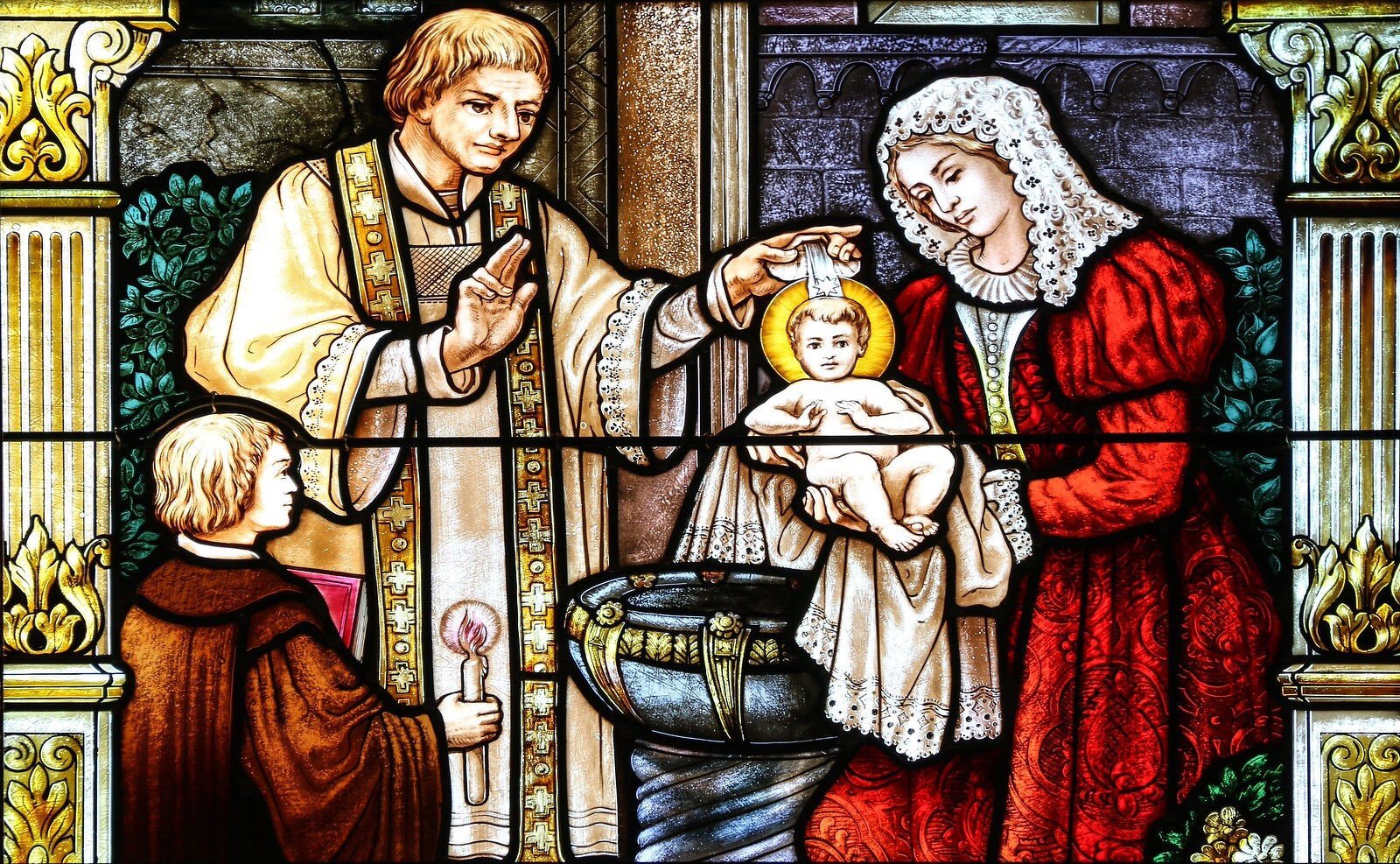 The first baptism happens at St. Joseph’s Catholic Church.
My family, long Catholic, continues the family tradition of dressing their newest member in a white, frilly gown and having a priest pour water over my head. This is a sign of entrance into the larger community of Catholics, and it’s the first step towards cleansing my soul from its original sin. I don’t remember this baptism, obviously, but I’m sure my family had a big party afterwards where there was beer and cake for everyone. I’m basing this on future baptisms I attended, including the one where I drank a lot of wine coolers, smoked a cigar with my cousins, then threw up in the bathroom.
The second baptism happens at First Baptist Church Garland.
I had started attending the church a few months prior during the summer. Some friends of mine invited me, and I, summer bored before I had a car and a job, decided to go primarily to scope out the Baptist babes wearing shorts and spaghetti straps. However, I found myself intrigued by the way church was happening there. It had always been a burdensome chore I hated. This, on the other hand, was something different.
The dark room, the acoustic guitar strumming three chords with the lead guitar playing riffs over it - this all felt different. The musicians were not adults - they were other kids I’d known from school, too. It seemed like it had something to offer, so I kept coming back. I eventually did the Evangelical deed: I invited Jesus into my heart. Ironically enough, I did this in a small study room at the aforementioned St. Joseph’s after leaving Mass and reading Matthew 5:16.
After a few months, I knew I needed to be baptized again. The first one happened when I wasn’t even conscious yet - how could it count? I convinced my parents that I needed to do this, and they begrudgingly went along. I wrote my testimony, and on some Sunday morning service, at 17, I was baptized by my youth pastor, Patrick.
The third baptism happens in the freezing cold shower at my parents’ house.
I’m 25 years old, and in those intervening years since the second baptism, I’d gotten a degree in Biblical Studies with the eventual goal of becoming a pastor. I’d been so moved by the story of Jesus that I wanted to help others do the same. After college, I began an “apprenticeship” at a local church with the eventual goal of leaving the church with a group of people and start another one. This was not a paid gig, so I worked full time at Half Price Books, which, for a liberal arts major like me, was glorious.
But something coalesced during this time: God became too large for the Evangelical framework I was trying to contain it in.
I was taught that God was all powerful and all loving, yet he required a sacrifice to be able to interact with his creation because of his purity. But, as I neared the end of my degree and into the apprenticeship, I kept learning more about the Christian tradition outside of Evangelicalism, reading theologians and philosophers that the vanguard of conservative Evangelical thought warned us against. The vast differences in these perceptions of God stirred deep doubts about the whole enterprise.
This resulted in a long period of time where, externally, I identified as a Christian, went to church, raised my hands during the big worship choruses, etc. Internally, doubt about all of it roiled within me. An internal voice would ask if I truly believed in all of this, and I had to keep telling it, “Yes, of course!” But I grew tired of it. The doubts began to make more sense than the information in front of me.
On this random morning in late March, as I’m getting ready to go to work at Half Price Books, I enter the shower and the litany of doubts began their work again. Maybe I was just tired on this particular morning, but I’d had enough of trying to convince myself I still believed. By the end of the shower, I’d decided to see what would happen if I embraced the doubt. I entered the shower with my life going one direction; I exited it into a brand new vista.
In the intervening years since the third baptism, I began to explore widely across traditions, disciplines, philosophies, religions. During this process, I ended up (like many an Exvangelical) reading a lot of the work of Richard Rohr, a Franciscan priest. And yes, the irony of that is delicious.
Fr. Richard proposes there are three phases of life: Order, Disorder, Reorder. Order arises when we’re young to help build us a framework to navigate the human experience. Disorder happens to us as a wound to that framework. Reorder arises when we’ve learned to transcend and include both the Order and the Disorder phases to become someone new.
The Bright Sadness is an exploration of being on this Order-Disorder-Reorder carousel ride, specifically around the framework and experiences one uses to navigate the immense mysteries of existence and life. I’m writing this project in hopes to connect with others who have been and/or are on these trajectories. It’s less about deconstruction (although I’ll talk about it, obviously) and more about what happens after it, a long time after.
(A quick note: these Order-Disorder-Reorder phases are not a one and done type of event - they happen over and over again in different parts of our lives, both the cosmic and the mundane. For example, I recently entered a Reordered phase with cherries - I apparently DO like them!)
My third baptism, at first glance, seems like it’s focused more on the Disorder part of my framework story. It became a personal, accidental symbol of me giving up on Jesus and how I’d understood him and his story. But one of the joys of getting older is you get to look back on the previous iterations of yourself with clarity. And with the clarity of hindsight, that baptism wasn’t about entering Disorder; it was the first step towards Reorder.
I just didn’t know it yet.